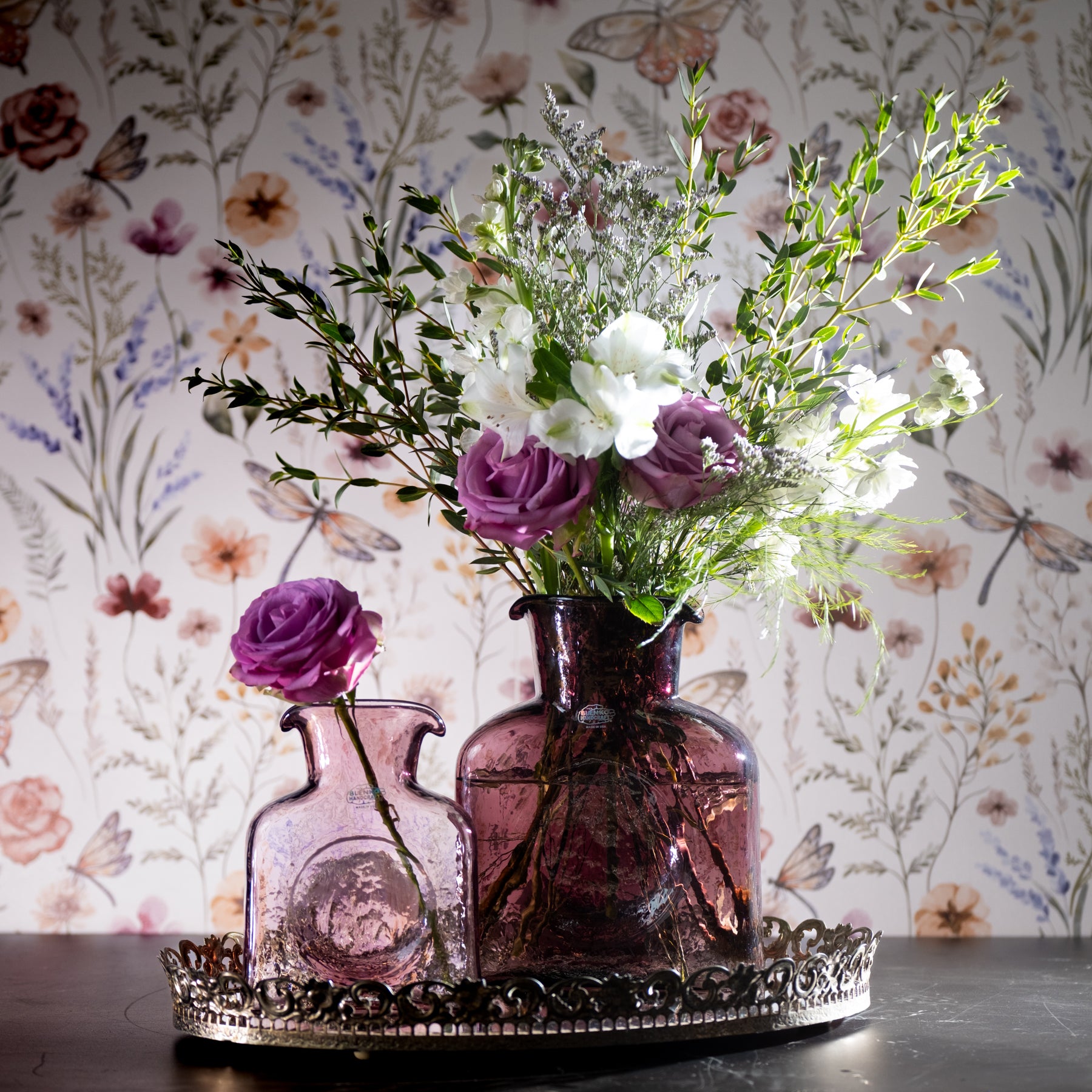
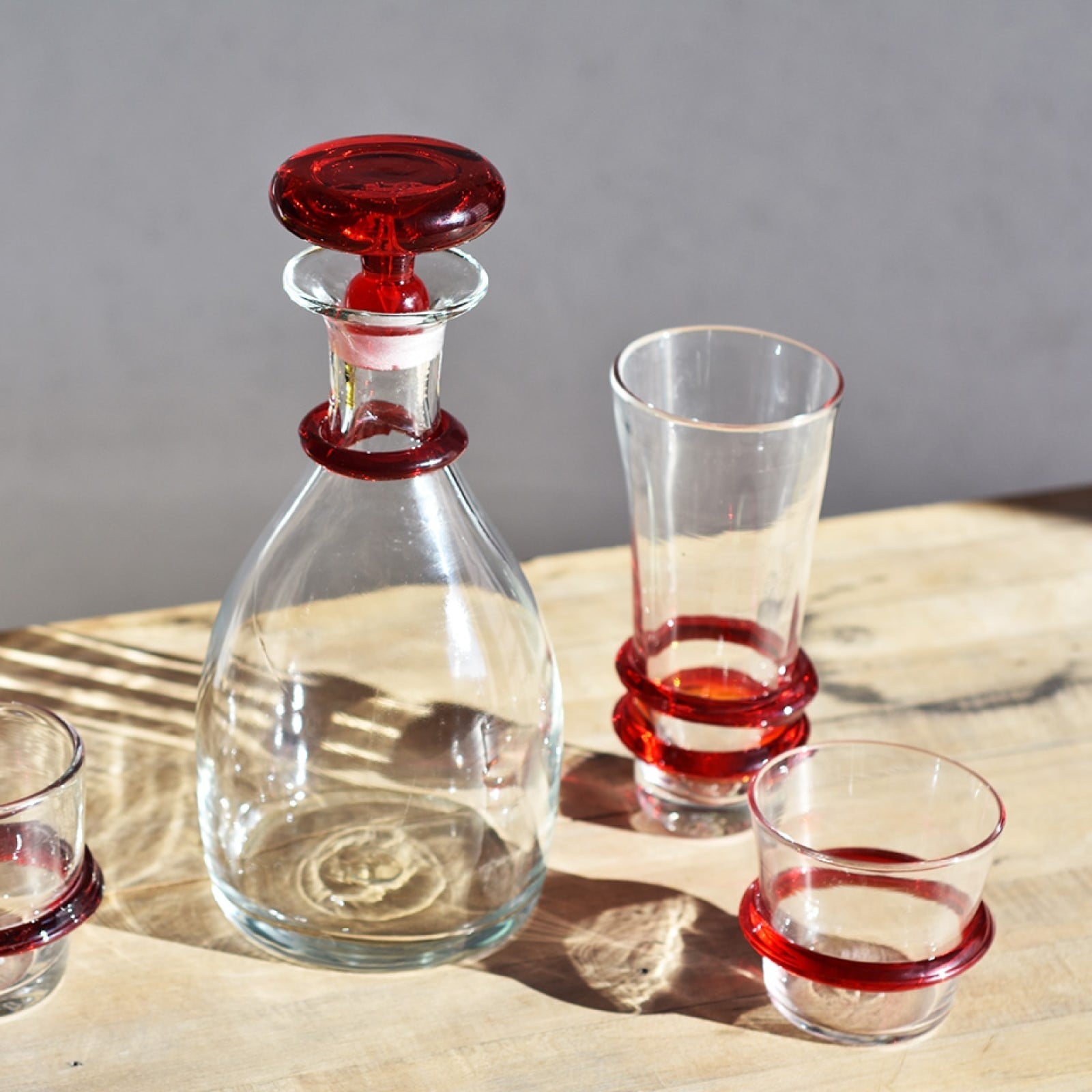
If so, a trip to the Visitor Center is the perfect opportunity to find a unique piece for your collection that can only be found at the Blenko Visitor Center. Come see our assortment of prototypes, artist whimsies, discontinuations, and other experiments in shape and color as well as our most iconic standard line items like the 384 Water Bottle, Suncatchers and more!
There is a perfect piece for everyone.
Come visit us today!
*Cullet and scrap glass is no longer available for purchase in our Visitor Center Gift Shop.
Store Hours:
Mon-Sat: 9am-5pm Sunday: 12noon-5pm
Address:
9 Bill Blenko Drive Milton, WV 25541
Phone:
(304) 743-9081
Milton, West Virginia · Opened 1966
The Visitor Center
A building made of its own product, opened in the summer of 1966.
A By-Product of the Centennial
The Center began as an idea for West Virginia's 1963 Centennial. In the late summer of 1962 the company started giving serious thought to a place built to receive and entertain guests, and for a short while considered a crash program that would have something standing in time for the Centennial crowds. That idea was dropped. The Blenkos decided that a place to show and sell their glass had to be as distinctive as the glass itself, and distinctiveness is not conjured up on short notice.
So they started with the ground rather than the building. Boggs and Rehm of St. Albans were engaged to study the available sites and to lay out the grounds and a lake area. The lake gave them most of what followed.
The Building
The building went up under Zando, Martin and Milstead of Charleston, with Lyle Bledsoe of Milton as builder. Because the site lay twelve feet below the level of the plant, they made it two stories. The lower floor held the sales area, sized to handle volume and set close to the parking lot for the many visitors who came only to buy glass. The upper floor held a glass museum and the assembly area where plant tours began and ended. A wide stair with carpeted treads joined the two.
Glass went into the fabric of the building and not only into its cases. The panel strips along the ground floor were masonry surfaced with embedded glass nuggets, and the roof deck, visible from the second floor, was sprinkled with the same, like sand on a beach. The choice was practical as much as decorative. Glass is not affected by the elements and is almost everlasting, which made it a building material as well as a product.
The original design had carpet run throughout. The architect gave two reasons for it: carpet cut the noise, and it cushioned the glass that visitors were bound to drop.
A covered walkway connected the Center to the plant. It was roofed against the weather but left open at the sides, so the walk took in the wall of flue pipes, the working yard and the glass dump. That was deliberate. The instruction to the designers had been that nothing should be built which took away from the excitement visitors got from a tour. The Center was to be where a tour began and ended, not a substitute for one.
The Garden of Glass
The garden beside the factory was Marion Blenko's cause. Boggs and Rehm designed it, and Joel Philip Myers, the company's design director, made its glass: nine hundred and ninety-nine abstracts set into thirty-seven panels of bleached redwood. Every one was created for the garden. None was a sample of anything the company sold, though the display was meant to raise interest in buying dalles.
The redwood was bleached on purpose, to bring on in weeks the weathered silver that would otherwise take five or six years, and to keep the color of the wood from competing with the browns, yellows and reds of the glass. Each panel was square, so the glazed third could be turned to sit differently against its neighbors. The walks were casual trails, laid to make a visitor pause and look, with concrete benches to sit on.
The lake carried the composition. A fountain threw jets of water ten feet into the air from a man-made lagoon on the shoreline. Two redwood bridges crossed to an island, and a footbridge ran to a sun deck and a boat landing. Coming up the winding drive toward the parking lot, a visitor's eye swept the lake and the garden before it reached the building, and from inside, the lake showed from the sales floor and from the museum above it.
“It was my intention to explore the multitude of creative avenues open to the artist working in glass; to exploit the plastic, molten mass; to impress designs deeply into the hot mass, to swirl and dig into the soft stuff; to draw, and to dribble.”
He made one panel by dragging a piece of iron chain mesh through the glass, and another by dribbling strands of hot blue glass over hot crystal. Color gave him a problem to settle before anything else. Light both reflected off the surface of a slab and passed through it, and dark colors proved too dense to read; not enough light came through to translate them. He chose a predominantly light palette and worked from there.
“It was our intention to present to the public beautiful glass which would be enjoyed by everyone,” Myers said. “It is my hope that this Garden will encourage and inspire a new and creative use of glass.”
Nine Studios
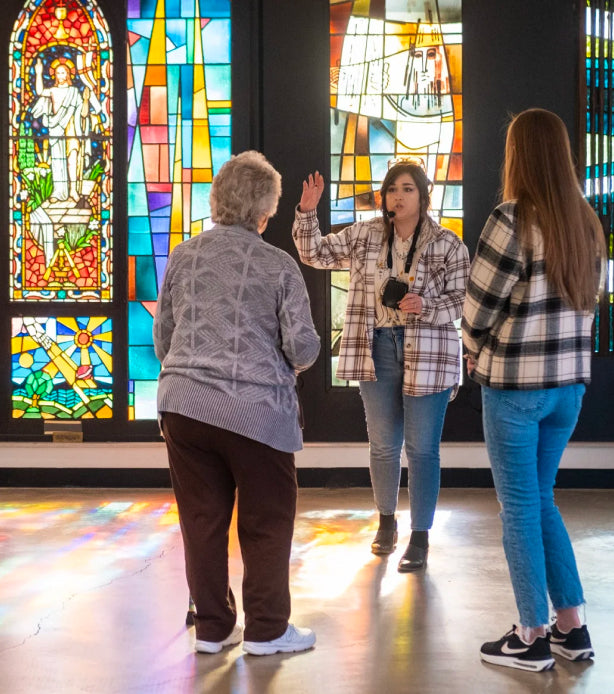
The museum on the second floor carried panels from American stained glass studios that had been using Blenko glass for years. Each was invited to create one of its own design for permanent display, and nine accepted: Orco Studios of San Antonio, Willet Studios of Philadelphia, Hunt Studio of Pittsburgh, Rambusch Decorating Company of New York, Franklin Art Glass of Columbus, Emil Frei Associates of St. Louis, Judson Studios of Los Angeles, Universe Art Studio of Winona, and Conrad Schmitt Studios of Milwaukee.
One of the nine was family. Hunt Stained Glass Studios of Pittsburgh was Henry Hunt's firm, and his daughter Marion had come to Milton in 1923 as W. H. Blenko's wife, staying with the company for the rest of her life.
The Opening
The Center was dedicated at eleven o'clock on Thursday, July 28, 1966, with Governor Hulett Smith present and the public invited to attend. It stood half a mile off U.S. Route 60 and a mile off Interstate 64 at the Milton interchange. Better than two hundred people worked at the plant that year. W. H. Blenko was president, and his son W. H. Blenko Jr., who had come home to the factory in 1946, was executive vice-president.
That summer the artist Charles Harper, a native of French Creek, West Virginia, visited and sketched the new building. His drawing ran in the June 1966 issue of Ford Times alongside a feature on West Virginia specialty glass.