Skip to content

Blenko History

Blenko Glass Company · Milton, West Virginia

The Blenko Century

Ten decades of handblown color, traced and sourced.

Sources are listed at the foot of each section; hover any for details.

1854–1893

London Beginnings

William John Blenko was born in London on December 8, 1854, to a working-class English family, and was apprenticed to a glass craftsman as a boy with his mother's encouragement. He attended night school, studied under the philosopher John Tyndall, and by the early 1880s had gone into business for himself making rondels, the round window panes of the stained glass trade, while experimenting with processes for making glass superior to that of his competitors.

The trade he entered was an ancient one, closer in spirit to alchemy than to industry. There is nothing less promising than the raw materials of glass: a pile of sand, some soda or potash, lime, and a handful of metallic oxides. Pliny credited Phoenician sailors with its accidental discovery on a sandy riverbank; modern scholarship favors Egypt, some twenty-five centuries before the common era. The blowpipe, probably a Syrian invention, made production possible on a wide scale and remains the only method used at Blenko for hollow ware to this day.

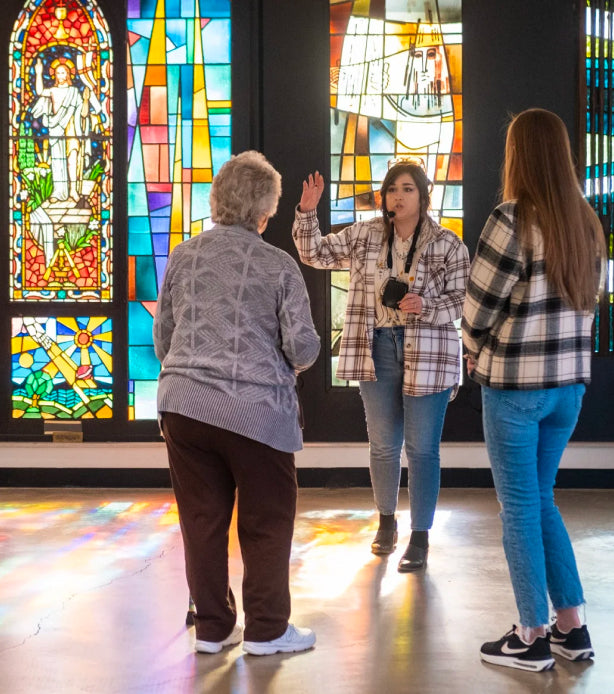
Rome made glass an industry, producing everything from medicine bottles to luxury drinking ware. Venice made it an art: for centuries the city-state guarded its methods so jealously that “flacon de Venise” meant the finest glass in the world. By the 1600s the secrets had escaped across Europe, to France, Sweden, Germany, and England, and with them spread the endless pursuit of finer color. A glassmaker of that era proceeded by trial and error, logging every successful color recipe in a carefully guarded book. Color mattered nowhere more than in stained glass, the medium in which every town's cathedral concentrated the work of carpenters, masons, carvers, and glaziers. The medieval glass was uneven, full of seeds and ripples, and that is precisely what made it luminous. Nineteenth-century mechanization displaced the old methods and lost that character; recovering it became William Blenko's life work.

Sources: Wilson 19871

Portrait of William J. Blenko
William John Blenko, 1854–1933.2
1893–1920

Kokomo and the Failed Starts

In 1893, at the age of thirty-eight, Blenko sailed for America to make antique glass in a country that produced none domestically, drawn in part by the promise of the wonder fuel of the age, natural gas.

“William Blenko, an English glass manufacturer, has come to Kokomo, bringing with him the machinery for establishing a plant for the making of cathedral and other glass.”The Kokomo Dispatch, January 23, 18931

He built the twenty-by-forty-foot shop largely with his own hands and had glass in production by spring. Almost nothing else went right. A tariff reduction on imported glass undercut his prices; a recession dried up orders; and above all he met a settled prejudice among American stained glass studios, most of them European-trained, that fine glass could only be European. After nearly ten years he was forced to return to England, where he continued in the trade and refined the cylinder method: glass blown into the shape of a large closed bottle, roughly twenty inches by eight, then cut and flattened into sheet.

He tried America twice more, at Point Marion, Pennsylvania, in 1909 and at Clarksburg, West Virginia, in 1911. A four percent tariff reduction in 1913, slow orders, and rising payroll costs ended the third attempt. Through the failures he kept working at the problem that had defeated glassmakers for generations, a ruby glass that would hold its color when reheated, and supported himself as an industrial chemist, at one point fielding a job inquiry connected to Tiffany. Away from the furnace he played a wicked game of chess and was an accomplished flute and piccolo player.

The Kokomo years also produced the company's most surprising chapter: a lifelong friendship between the fledgling capitalist and Eugene V. Debs, America's leading socialist and five-time presidential candidate. Having come from a working-class family, Blenko retained a lasting sympathy for the dispossessed. Letters passed between the two families for decades, and when Debs was imprisoned at Moundsville, West Virginia, in 1919, Blenko visited him there.

Sources: Wilson 19871

“The message of love and loyalty from your heart to mine is enough and it touches me more deeply than can be expressed in words. I hope you and Mrs. Blenko and the dear children are all well.”Eugene V. Debs, in a letter to the Blenko family1
Early factory work at Blenko, from the company archives
From the production floor archives.
1921–1929

Milton

In 1921, at the age of sixty-seven, Blenko tried a fourth time. The industrial development department of the Chesapeake & Ohio Railroad sold him on Milton, West Virginia: dependable, sober labor; cheap natural gas for the furnaces; and a rail line for shipping. His plant, the Eureka Art Glass Company, was by every account a shack, some twenty by forty feet with a steel roof and frame walls. He slept on a makeshift cot supported by two spare tires in a corner of the shop and lived on three dollars a week.

The town adopted him. Young people sought him out, and country people on their weekly visits would stop at the shop to watch in amazement as he made a product for which they had no name. His son William H. Blenko Sr. yielded to his father's requests and moved to Milton in 1923, an able glassmaker and a better salesman, with his wife Marion, daughter of Henry Hunt of Hunt Stained Glass Studios in Pittsburgh.

Then, at last, the breakthroughs three decades had withheld. After a year of headaches the first check for glass arrived. The elusive ruby was perfected in 1924. A patent for the cylinder method of making antique sheet glass, filed in February 1924, was granted in May 1926. And in 1927 a letter arrived from Champness and Company, a London building materials firm: “you can take it from me that your glass will go into the Liverpool” cathedral. English glass prejudice had been answered from a hillside in West Virginia. The septuagenarian moved out of the shack and into a house.

Sources: Wilson 19871 · e-WV2 · Crain 20075 · U.S. Patent 1,583,44110

Early Blenko factory production floor
The Milton production floor, from the company archives.
1930–1946

The Turn to Decorative Ware

The Crash of 1929 froze construction, and with it the stained glass trade. For a producer of what the market deemed non-essential goods, the arithmetic was existential. William H. Blenko Sr. concluded that diversification was the key to survival, and his father, devoted as he was to the stained glass craft, came to concede the necessity. In 1930 Eureka Art Glass became the Blenko Glass Company.

It was one thing to decide to make decorative ware and another to make it. Bill Blenko traveled to Pennsylvania to recruit skilled workers and found Axel Johnson, a Swedish blower who knew the intricacies of the trade; Swedish craftsmen trained the Milton crews to shape tableware by hand. Macy's began carrying Blenko glassware in 1932. In 1936 Blenko became the exclusive manufacturer of Colonial Williamsburg’s eighteenth-century glass reproductions, a program the company’s own catalogs record as running from 1936 to 1966.

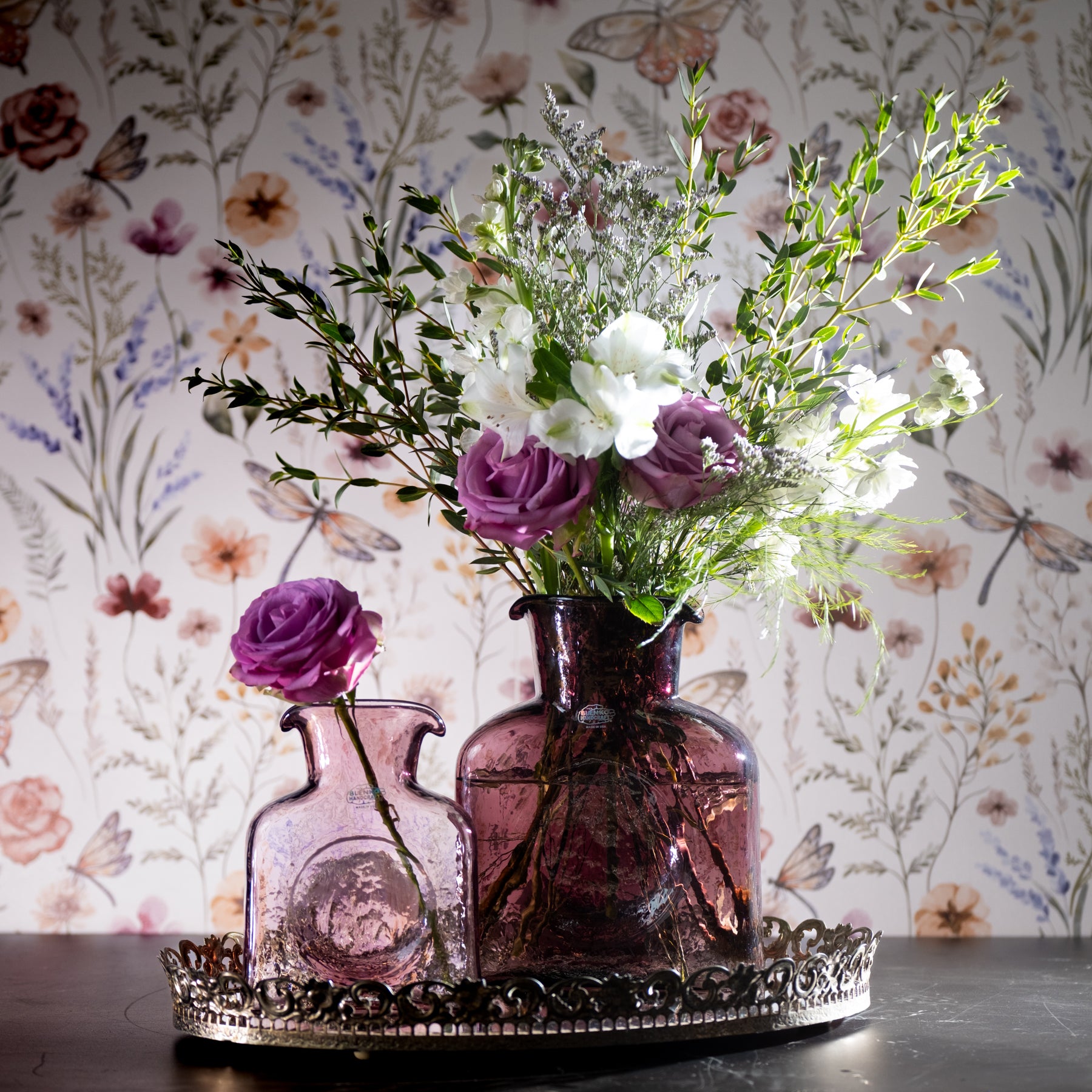
In 1938 a rectangular water bottle, catalog number 384, was designed to fit the shelf of a refrigerator door. It has been in continuous production ever since and remains the company's best-known design. Recognition came quickly: a Blenko pitcher appeared in the Museum of Modern Art's Useful Objects of American Design in 1940, the first of nine MoMA exhibitions to include the company's work, and by the mid-1940s Blenko had been featured in Time, National Geographic, House Beautiful, and House and Garden. The founder did not live to see most of it; William John Blenko worked until his death in 1933, at seventy-eight.

Sources: e-WV2 · Wilson 19871 · Casto 201913 · Shotwell 200212 · company catalogs22 · MoMA7

Vintage Blenko decorative ware on display
Early decorative ware of the kind that carried the company through the Depression.
Vintage Blenko glass pieces
Ware from the first decorative decades.
1947–1962

The Design Era

In 1947 the company hired Winslow Anderson, a ceramicist from Alfred University with no experience in glass, as its first resident designer.

“For a company to demonstrate such faith in a designer was new, daring, and virtually unheard of.”Damon Crain, Journal of Antiques and Collectibles4

Anderson's best-known piece, the No. 948 bent-neck decanter, began as an accident: a decanter slumped while the glass was still molten, and Anderson saw a design where the shop saw a loss. It went on to the Museum of Modern Art's Good Design exhibitions, where Blenko appeared in 1950, 1951, and 1953; three Blenko pieces remain in MoMA's permanent collection. Anderson left in 1953 to become design director at Lenox, and in retirement returned to a cottage in Milton, near the factory, where he died in 2007. The greater part of his estate went to the Huntington Museum of Art.

Wayne Husted, another Alfred graduate, arrived in 1952 and took over design on Anderson's departure, producing in a decade more than six hundred designs, including the architectural-scale floor pieces, some three feet tall, for which collectors know the period. He initiated the centrifugal spin-mold process at Blenko in 1961, and his bifurcated bud vase represented the company in Glass 1959 at the Corning Museum of Glass, a survey of more than 1,800 objects from twenty-three countries. Decades later, Husted returned to design for Blenko around the turn of the millennium; his Patriot decanter, in red and blue, answered September 11.

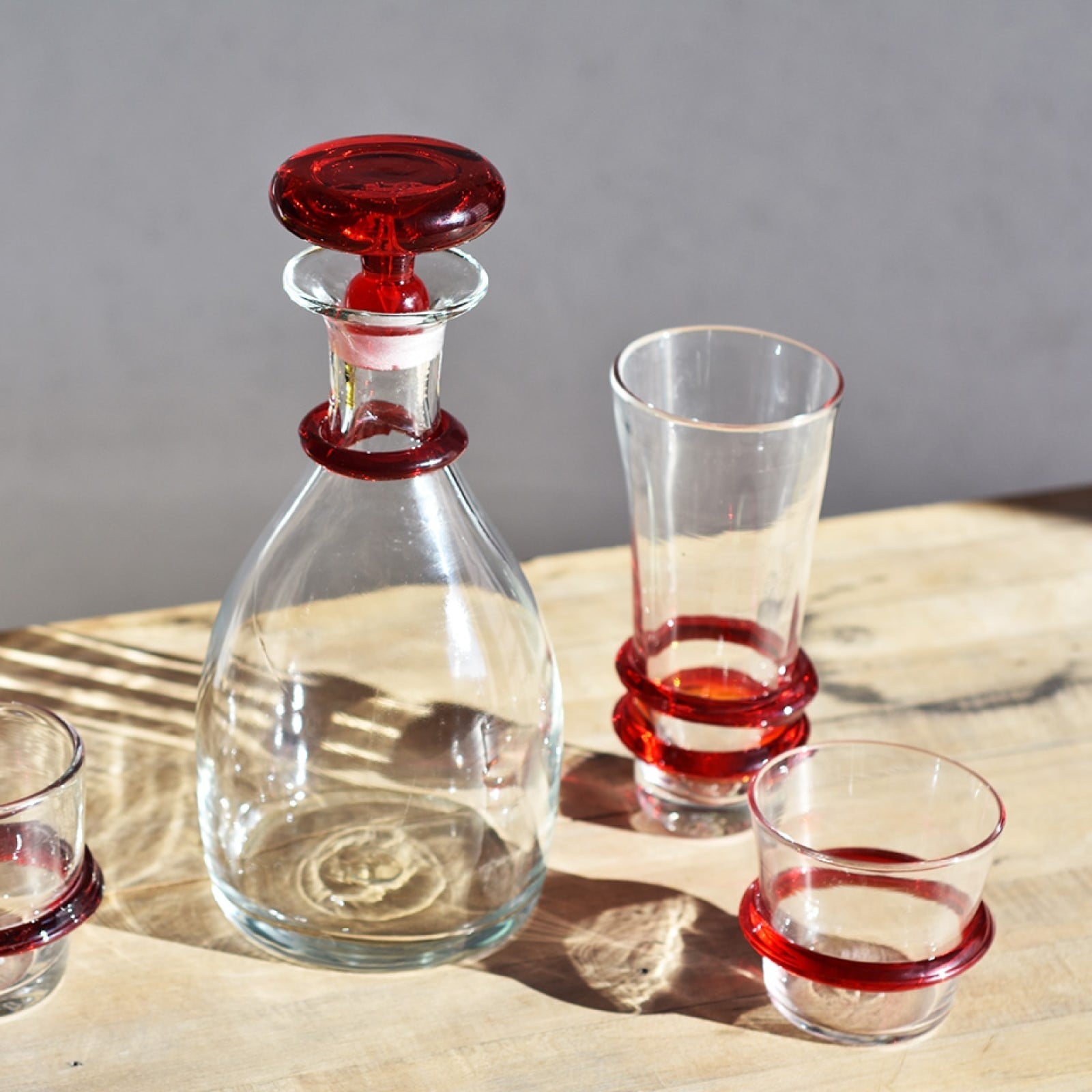
The same years brought technical range and reach. In 1955 Blenko became the first American producer of dalle de verre, thick slab glass set into concrete in modern architecture, later used in the chapel of the U.S. Air Force Academy. The catalogs of the era track an expanding palette: turquoise, amethyst, tangerine, and sea green by 1957; peacock, plum, and wheat in the 1960s. The first color catalog appeared in 1959.

Meet every designer in the lineage, 1947 to today →

Sources: Crain 20044 · MoMA7 · Herald-Dispatch 200714 · Blenko Project15 · Corning Museum8 · Shotwell 200212 · contemporary press18 · Bard Graduate Center6

Mid-century Blenko designs on display
Mid-century ware of the design era.
Blenko designs of the design era
The expanding palette of the 1950s and 1960s.
1963–1979

The Studio Glass Years

Joel Philip Myers arrived as design director in 1963, a Parsons-trained designer who had studied ceramics in Copenhagen and at Alfred. He taught himself glassblowing on the factory floor by watching the crews, the first studio artist to hold the post and the first Blenko designer to both design and personally blow glass.

“Had I not been aware of the Toledo glass seminars I wonder if I would have seen the dual possibilities of producing glass myself while designing for the factory.”Joel Philip Myers4

When American artists began making glass outside factory walls in the 1960s, high-quality material was nearly impossible to find, and Blenko supplied it. Myers shipped barrels of colored cullet to teaching programs across the country; a secondary dealer in Williamstown supplied, by Myers's estimate, ninety percent of the glass studios in the country.

“Blenko used to give barrels of glass to anyone who asked for it, and then was open to letting people like Howard Ben Tré go down and build a special kiln.”Toots Zynsky, studio glass artist6

Myers left in 1970 to found the glass program at Illinois State University; his work now sits in the Art Institute of Chicago and museums from Prague to Hokkaido. John Nickerson followed (1970–1974), then Don Shepherd (1974–1988), an architect-designer who experimented with unconventional mold materials, down to coat hangers, and who with Howard Ben Tré built the specialized annealing oven that let Ben Tré cast his large-scale works at the factory. In 1976 the NEA-funded New American Glass: Focus West Virginia brought studio artists, among them Fritz Dreisbach, nominated by Myers, to work at Blenko; the resulting prototypes entered the Huntington Museum of Art's permanent collection. Many studio glass artists of that generation had never set foot in a factory before Blenko opened its door.

Sources: Bard Graduate Center6 · Blenko Project15 · Huntington Museum9

Glassblowing at the Blenko factory
Hand production on the Milton floor, unchanged in method.
1980–Today

The Collector Era

In 1980, in partnership with Charleston's Diamond Department Store, the company made 117 commemorative bowls, designed by Don Shepherd, for West Virginia's 117th birthday. The edition number of the annual series rises each year to equal the age of the state, and the pieces routinely sell out within three hours of the doors opening on West Virginia Day. Hank Murta Adams, among the last Rhode Island School of Design students trained under Dale Chihuly, served as design director from 1989 to 1994, achieved record sales, redesigned the water bottle molds, and pushed for the recognition of the workers themselves; the catalogs of the 1980s began crediting individual glassmakers by name. Matt Carter, Arlon Bayliss, and their successors carried the design line forward.

Explore the West Virginia Day pieces, year by year →

In 1992 Blenko produced restoration window glass for the White House; its globes light the U.S. Capitol, and for years its trophies were handed out at the Country Music Awards. The 1998 documentary Hearts of Glass called Milton the last great American glass factory where all the work is done by hand.

Survival in these decades was earned more than once. A natural gas crisis squeezed the company hard in 2003; in January 2009 a creditor's bank seizure briefly cooled the furnaces until collectors bought enough glass to restart them within six weeks; and a Chapter 11 reorganization begun in 2011 ended in 2013 with the company's debts, including a decade of back taxes, repaid in full.

Collectors organized around the factory: a Blenko Collectors Society formed in 2003, published a quarterly called The Blowpipe, and held its conventions at the plant; its gatherings grew into the annual Festival of Glass, held since 2009 and moved from August to spring after hot-shop temperatures reached 140 degrees. In 2021 the company marked one hundred years in Milton. Of the nearly five hundred glass factories that once worked the tristate region, fewer than a dozen remain. Blenko still gathers, blows, and finishes every piece by hand, from a palette of more than 1,300 colors.

Sources: Blenko Project15 · Bard Graduate Center6 · contemporary press18 · Hearts of Glass 199817 · Collectors Society20 · company records23

“Our furnaces burn 24 hours a day, day after day, year after year. We never turn them off.”Dean Six, Blenko, 201913
West Virginia Day commemorative piece
The West Virginia Day series, made annually since 1980.
Molten glass being worked at Blenko today
The furnaces, still burning.
Five Generations

The Blenko Family

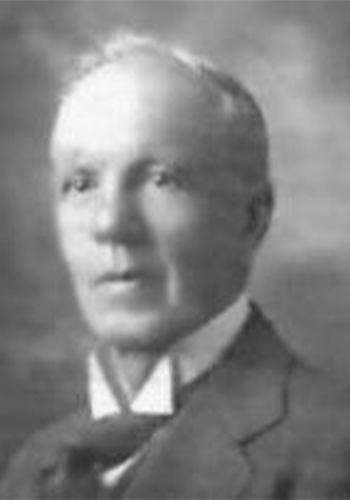
William J. Blenko
William J. Blenko
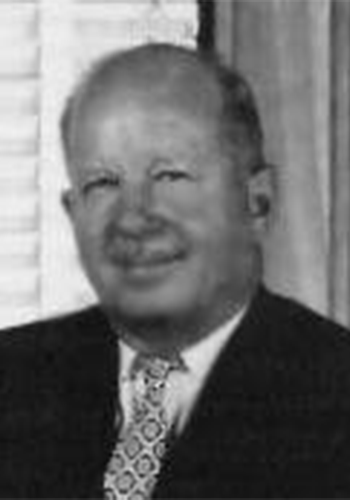
William H. Blenko, Sr.
William H. Blenko, Jr.
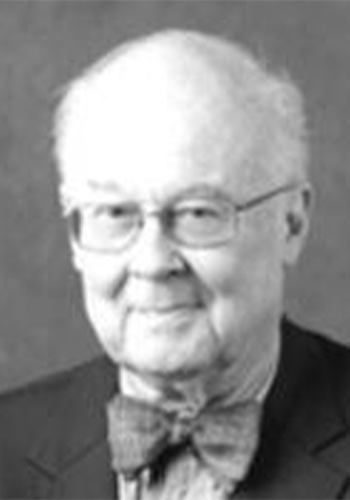
Walter J. Blenko, Jr.
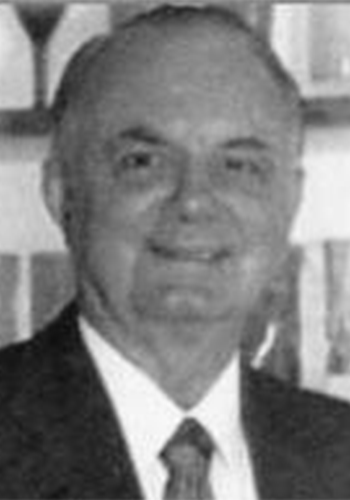
John W. Blenko, MD
John W. Blenko, MD

William J. Blenko, founder

Born in London on December 8, 1854, and apprenticed to the glass trade as a boy, William John Blenko spent thirty years and three failed ventures bringing antique glass manufacture to America before succeeding at Milton in 1921. He perfected the reheatable ruby in 1924, patented his cylinder method in 1926, and saw his glass chosen for Liverpool Cathedral in 1927. He worked until his death in 1933.

William H. Blenko, Sr.

The founder's son moved to Milton in 1923, learned the batch formulas from his father, and on the founder's death in 1933 became president, presiding over three decades of steady growth and the pivotal 1930 turn to decorative ware. He died in March 1969, at seventy-two. His wife Marion Blenko, daughter of Henry Hunt of Hunt Stained Glass Studios, worked seven days a week from 1923 until her death in 1989 as treasurer, secretary, and retail sales manager, sixty-six years of service.

William H. Blenko, Jr.

Introduced to the trade as a boy, he worked summers at the plant, graduated from the Carnegie Institute of Technology in 1942 with a degree in industrial engineering, and served as a captain in the U.S. Air Corps during the Second World War, meeting his wife while stationed in England. Released from duty in 1946, he returned to Milton and remained with the company just short of seventy years, as president and then chairman, until his death on February 5, 2016. He was widely honored in both the art glass and stained glass fields.

Richard Blenko

Richard Blenko began work at Blenko Glass as a very young man; he and his older brother would often spend their days with their Uncle Jim Derkin and the men from the plant, listening to the stories and watching glass being made. While his job was management, he was accomplished in the many tasks of running a glass company. He was the promotional face of Blenko, often called an ambassador for West Virginia glass, instrumental in the company's involvement with PBS, and a presence in the films documenting the company's history. He assisted with selecting and creating designs from 1980 to 2007, hand-signing his pieces throughout.

Walter J. Blenko, Jr.

A grandson of the founder, Walter J. Blenko Jr. served as a combat infantryman in Europe during the Second World War, graduated from the Carnegie Institute of Technology in mechanical engineering, and took a law degree from the University of Pittsburgh. After a career as a practicing lawyer he came to Blenko Glass, serving as president. He died at his home on August 11, 2019, at ninety-three. He was, in the company's words, a friend, mentor, and leader.

John W. Blenko, MD

The company's current president, John W. Blenko, MD, a physician by first career, is the sixth president in four generations of family stewardship.

Five generations, told in full →

Sources: Wilson 19871 · e-WV2 · Blenko Project15

The Method

No Assembly Line

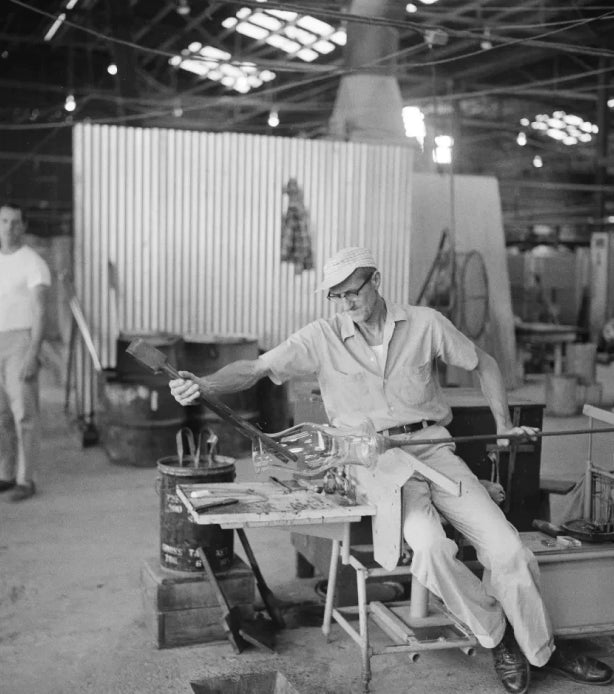
There is no trace of an assembly line at the Blenko plant; the feeling has been compared to stepping back into a medieval guild hall. Production is organized around teams of five or six, the gatherer, blower, finisher, bit boy, and carry-in boy, working in concert at furnaces of molten glass held near two thousand degrees. Shifts begin at six in the morning.

The process begins when the gatherer collects a gob of molten glass on the end of a blowpipe from a white pool that has been compared to the lake of fire of the Book of Revelation. The blower inflates and shapes it with wooden tools, then blows it into a hand-carved mold. The piece passes to the finisher, the most skilled member of the crew, who widens mouths, lengthens necks, and attaches handles, before the carry-in boy takes it to the lehr, the long annealing oven through which the glass cools slowly enough not to shatter. When the glass is hot there can be no hesitation: a minute too long in the oven and the colors change; a minute too long out and the glass becomes unworkable.

Roughly eight of every ten pieces are shaped in cherrywood molds carved by hand, an unusually high ratio among American factories; each mold serves fifty to one hundred uses before the glass burns it away. The floor has been a place of long tenures and family lines: blower Everett “Shorty” Finley, foreman Hinton “Jarfly” Richmond, who served the company for roughly fifty years, lead gaffer Dave Osburn, and crews of second- and third-generation glassmen.

A finished Blenko piece meets strict quality standards and still shows the marks of its makers, including the pontil scar on its base. The company regards these as evidence of the process rather than flaws, and workers have long been permitted the free use of the furnaces to develop their skill; some of their off-hours work has ended up in museums.

Sources: Wilson 19871 · Bard Graduate Center6 · Blenko Project15

A Blenko team working molten glass
The team at work: gatherer, blower, finisher.
Shaping molten glass by hand at Blenko
Wooden tools, wet and smoking, shape the molten gather.
The Record

Commissions & Placements

Blenko glass stands in some of the most visited buildings in the world. The record, by place:

  • Liverpool Cathedral, England (1927)
  • Cathedral of Reims, France (postwar restoration)
  • Washington National Cathedral
  • Saint Patrick's Cathedral, New York
  • Duke University Chapel
  • U.S. Air Force Academy Chapel, Colorado Springs (1962)
  • Seattle World's Fair, dalle de verre window (1962)
  • Grant's Tomb
  • The White House, restoration window glass (1992)
  • Blair House (1969) and the Smithsonian (1971), crystal lighting glass supplied through Lester Berry of Philadelphia
  • The U.S. Capitol, light globes
  • Colonial Williamsburg, all glass reproductions (1936–1966)
  • 1964 New York World's Fair, Hall of Science (dalle de verre)
  • Country Music Awards trophies
  • Presidential inaugural glassware (1981)
  • Pro Football Hall of Fame

Sources: Jackson 200011 · contemporary press18 · company records23

The Collections

In the Museums

The Museum of Modern Art holds three Blenko pieces in its permanent collection, each a gift of the manufacturer: a pitcher of about 1937, and a vase and ashtray of about 1946. The company appeared in nine MoMA exhibitions between 1940 and 1953, from the Useful Objects series through the Good Design shows of 1950, 1951, and 1953.

The Corning Museum of Glass holds Blenko work in its collection and the company's catalogs in its Rakow Research Library, including the 1951 catalog of Williamsburg Restoration reproductions; Husted's bud vase appeared in the museum's landmark Glass 1959 survey. The Huntington Museum of Art holds the prototypes of the 1976 Focus West Virginia project and the bequest of Winslow Anderson's estate. The Smithsonian American Art Museum holds the studio work of former design director Hank Murta Adams.

And in the sidewalk window of the Museum of American Glass in West Virginia, in Weston, stands Blenko Man: a near-life-size cowboy assembled entirely from Blenko glass by the collector Rock Wilson and the sculptor John Zidek, wearing a rare ruby hat, the color chosen with the help of Wilson's two-year-old son, and standing, by a quirk of assembly, on two right feet.

Sources: MoMA7 · Corning Museum8 · Huntington Museum9 · Herald-Dispatch 200714 · Bard Graduate Center6 · MAGWV16

Colorful Blenko glass vessels
The saturated color that carried Blenko into the museums.

Sources

  1. Rick Wilson, preface to Eason Eige and Rick Wilson, Blenko Glass 1930–1953 (Antique Publications, 1987).
  2. Rick Wilson, “Blenko Glass,” e-WV: The West Virginia Encyclopedia (West Virginia Humanities Council, 2024).
  3. Rick Wilson, “We’re in for it: Early Days at Blenko Glass,” Goldenseal, Fall 1987.
  4. Damon Crain, “Blenko: Uniquely American Modernist Glass,” Journal of Antiques and Collectibles, April 2004.
  5. Damon Crain, Modernism magazine, Fall 2007.
  6. Bard Graduate Center, Voices in Studio Glass History: Blenko Glass Company.
  7. Museum of Modern Art, collection and exhibition records for Blenko Glass Co. (objects 156.1947, 60.1948, 58.1948).
  8. Corning Museum of Glass, collection and Rakow Research Library records, incl. Glass 1959.
  9. Huntington Museum of Art, New American Glass: Focus West Virginia (1976) and Focus 2 (1986).
  10. U.S. Patent 1,583,441, William Blenko, “Art Glass and Method of Making the Same,” filed 1924, granted 1926.
  11. Lesley Jackson, 20th Century Factory Glass (Rizzoli, 2000).
  12. David J. Shotwell, Glass A to Z (Krause Publications, 2002).
  13. James E. Casto, “Inside the Blenko Glass Company,” Roadtrippers Magazine, December 2019.
  14. “Blenko Glass family mourns death of its first designer, Winslow Anderson,” Herald-Dispatch, 2007.
  15. The Blenko Project, designer, craftsmen, and birthday-piece archives.
  16. Museum of American Glass in West Virginia, Weston, WV.
  17. Hearts of Glass: The Story of Blenko Handcraft (1998).
  18. Contemporary press: Charleston Gazette (1957); Charleston Gazette-Mail (1962); Herald Star (1992); Clearfield Progress (1995).
  19. Blenko Glass Company, 2002 catalog.
  20. Blenko Collectors Society site and convention records (2003–2008); Festival of Glass reporting, The Real WV (2024) and Herald-Dispatch.
  21. Blenko Glass Company, “Is This Blenko?” identification series.
  22. Blenko Glass Company catalogs, 1940–2023: company archive transcriptions of sixty-eight catalogs, price lists, and seasonal supplements.
  23. Blenko Glass Company records, Cabinet 1 scan archive (indexed 2026): contracts, correspondence, press clippings, and photographs.